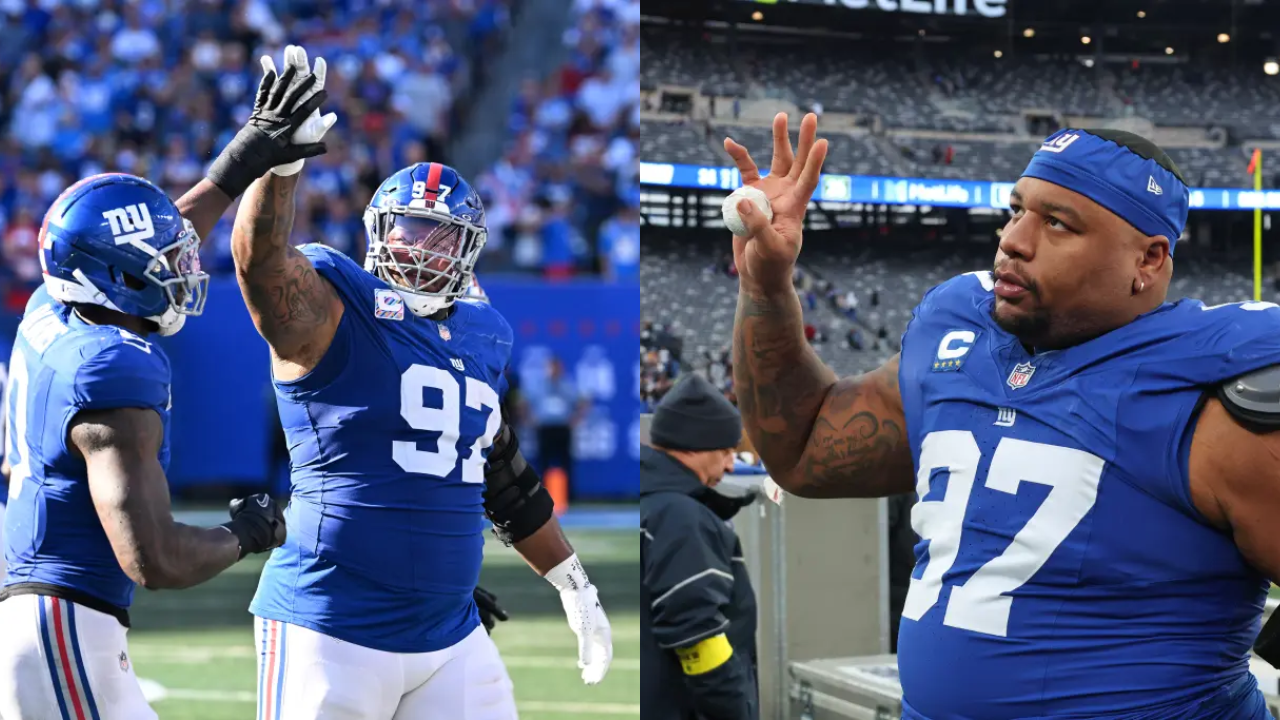
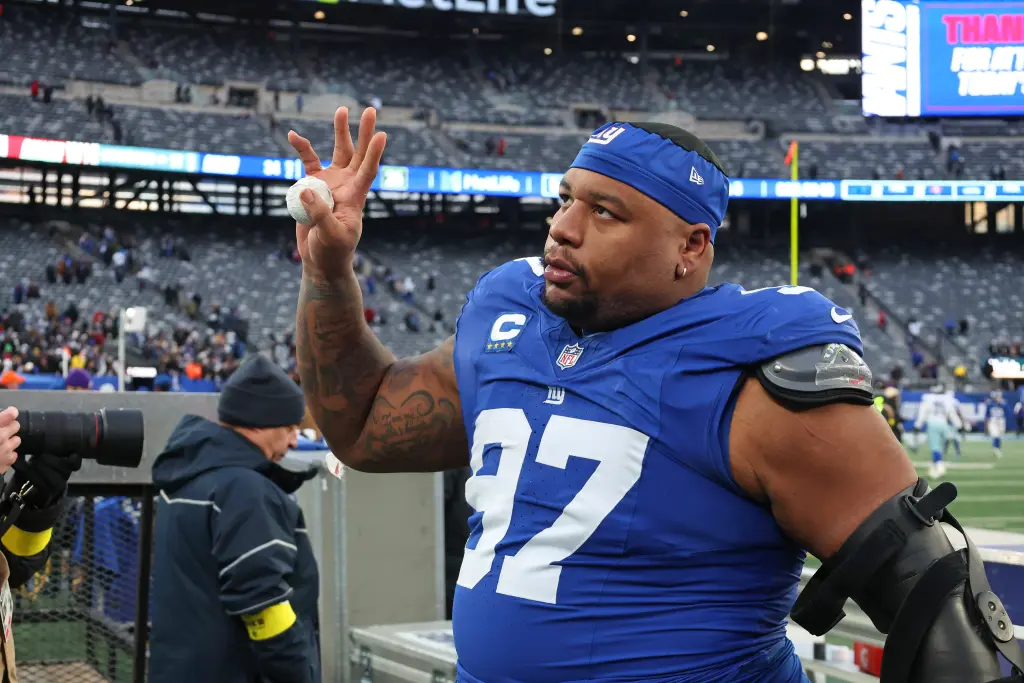
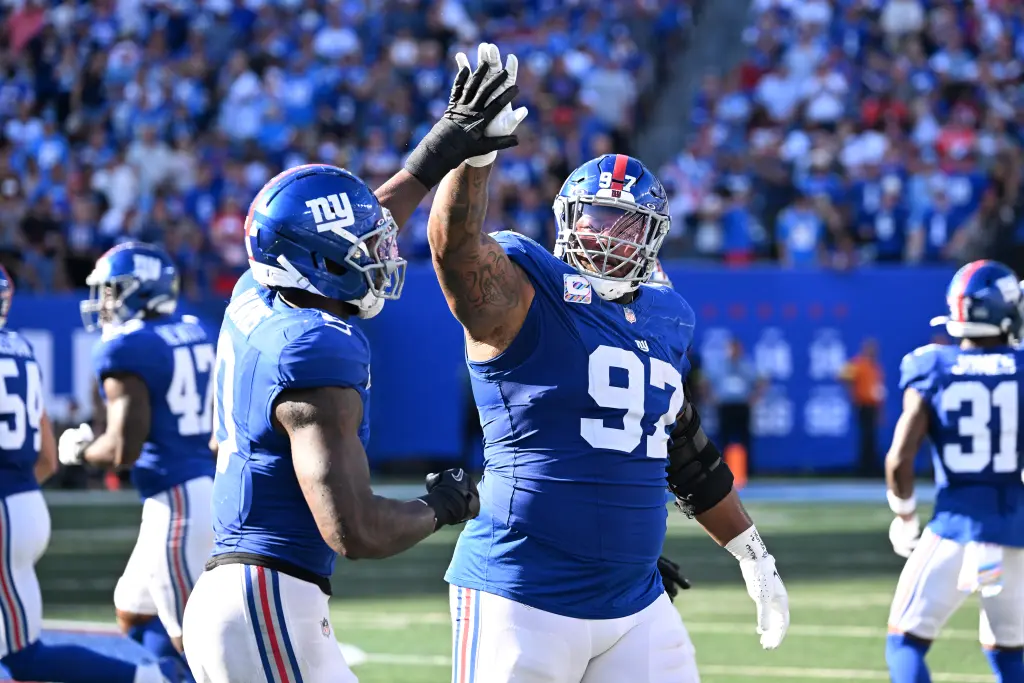
The Dexter Lawrence era in New York is over. The three-time Pro Bowl defensive tackle was traded to the Cincinnati Bengals on Saturday night in a blockbuster deal that sends the No. 10 overall pick in the 2026 NFL Draft to the Giants, according to multiple reports.
The trade, first reported by NFL Network’s Ian Rapoport and Mike Garafolo, ends a two-week standoff between Lawrence and the Giants after the star defensive tackle publicly requested a trade on April 6, citing stalled contract negotiations and growing frustration with the franchise’s direction. The deal is pending a physical.
For the Giants, the move reshapes their entire draft strategy. New York now holds two top-10 selections — Nos. 5 and 10 overall — giving new head coach John Harbaugh and general manager Joe Schoen unprecedented ammunition to accelerate a rebuild that went 4-13 in 2025. For the Bengals, it’s a win-now declaration: Cincinnati is sending a clear message to franchise quarterback Joe Burrow that fixing the league’s 31st-ranked defense is priority No. 1.
The Deal: Straight Swap for a Top-10 Asset
The trade is believed to be a straight one-for-one swap: Lawrence for the 10th overall pick. No additional picks or players are involved, according to league sources.
| Trade Details |
|---|
| Giants receive: No. 10 overall pick (2026 NFL Draft) |
| Bengals receive: DT Dexter Lawrence |
The move marks the first time since 1989 that the Bengals have traded away their own first-round pick — and the first time in franchise history they’ve surrendered a top-10 selection for a player. It’s a stunning departure from Cincinnati’s traditionally conservative approach to roster building, but it reflects the urgency of a team that watched its championship window with Burrow narrow after back-to-back disappointing seasons.
For New York, the value is undeniable. The Giants now become just the 22nd team in the common draft era to hold two top-10 picks — and the fifth in the last five years to do so.
‘Sexy Dexy’: From Cornerstone to Disgruntled Star
Lawrence, 28, was the 17th overall pick by the Giants in 2019 out of Clemson. Over seven seasons in New York, he developed into one of the NFL’s most disruptive interior defenders, earning three straight Pro Bowl selections from 2022 to 2024 and second-team All-Pro honors in 2022 and 2023.
His nickname, “Sexy Dexy,” reflects both his personality and his production. According to Pro Football Reference, Lawrence has amassed 30.5 career sacks, 40 tackles for loss and 103 quarterback hits across 109 regular-season games. His 2024 campaign was arguably his best: a career-high nine sacks in just 12 games before a season-ending elbow injury derailed his momentum.
But 2025 was a different story. Lawrence recorded just half a sack — a career low — and 31 tackles in 17 games. His production dipped, but context matters. Per Pro Football Focus, Lawrence faced double teams on an astonishing 74.5 percent of his pass-rush snaps in 2025, meaning roughly three out of every four plays, offenses used at least two blockers to contain him. His PFF pass-rush grade of 84.5 still ranked seventh among all defensive linemen, and his overall grade of 75.6 was ninth among defensive tackles.
Yet the Giants balked at giving him a raise. And that’s where the relationship fractured.
Why Lawrence Wanted Out: Money, Losing and the ‘D+’ Report Card
Lawrence’s trade request was not impulsive. It was the culmination of two years of stalled negotiations and a growing sense that his prime was being wasted on a losing franchise.
He signed a four-year, $90 million extension with the Giants in 2023, but that deal quickly became outdated. The defensive tackle market exploded, with players like Philadelphia’s Jordan Davis (three years, $78 million) and New England’s Milton Williams (four years, $104 million) — neither of whom are Pro Bowlers — leapfrogging Lawrence on the pay scale. Lawrence, a three-time Pro Bowler, currently ranks 12th among interior defenders in average annual value, well behind the top tier led by Kansas City’s Chris Jones at $31.7 million per year.
He is due $20 million in salary and bonuses in 2026 — a figure one league source described as “just not reasonable” for a player of his caliber. With no guaranteed money remaining on his deal, Lawrence had leverage, and he used it.
But the dispute wasn’t solely about money. Lawrence grew tired of losing. The Giants are 7-27 in their last 34 games. He watched close friends — Leonard Williams, Julian Love and Saquon Barkley — leave New York and immediately win Super Bowls elsewhere. He was a leader in a locker room that graded general manager Joe Schoen a “D+” in the NFL Players’ Association’s most recent report card.
“He’s probably the best player I’ve ever played with,” Love told The Post at Super Bowl 60. “I want him to continue to get that shine, but I know it’s hard for those guys over there to lose. Cream always rises”.
Lawrence’s relationship with the Giants’ new regime under Harbaugh never found solid footing. The star tackle skipped the first two weeks of voluntary offseason workouts, forfeiting a $500,000 workout bonus. Harbaugh, for his part, tried to keep the door open.
“We want Dexter here,” Harbaugh said after the trade request. “I believe Dexter wants to be here, you know, that’s a good formula, but there’s business involved”.
Ultimately, the business couldn’t be resolved.
Why the Bengals Made the Move: Desperation Meets Opportunity
For the Bengals, trading for Lawrence is a win-now declaration aimed squarely at maximizing Joe Burrow’s prime. Cincinnati’s defense was historically bad in 2025: 31st in total yards allowed, 30th in points allowed and 30th against the run. They allowed 27 points and 350 total yards over eight straight games — a streak never before seen in NFL history, according to CBS Sports Research.
The team had already begun overhauling its defense in free agency, signing edge rusher Boye Mafe, safety Bryan Cook and defensive tackle Jonathan Allen. But none of those moves addressed the core issue: the absence of a true difference-maker in the middle of the defensive line.
Not since D.J. Reader’s heyday have the Bengals had a viable nose tackle to anchor their front. Lawrence fills that void immediately.
“OOOOH Weeeee,” Bengals linebacker Demetrius Knight Jr. reacted on X.
There’s also a Clemson connection: Lawrence and Bengals wide receiver Tee Higgins were teammates on the Tigers’ 2018 national championship team. The reunion adds a layer of familiarity to the transition.
Who Won the Trade? The Early Grades
NFL analysts are sharply divided on which team got the better end of the deal.
Giants Grade: A-
Most analysts praise New York for extracting maximum value from a disgruntled player. The Giants turned a contract dispute into a top-10 pick in a draft class that many scouts consider deep at premium positions.
- ESPN’s Seth Walder gave the Giants an A, writing: “I’ve always loved Lawrence as a player, but I am stunned by the draft capital the Bengals spent to get him”.
- The Sporting News called the deal a “proper haul” for a team trying to rebuild under Harbaugh.
- The Giants clear significant cap space: Lawrence’s $26.96 million cap hit in 2026 is off the books, creating room to sign their two first-round picks and pursue additional free agents.
The risk for New York is obvious: Lawrence’s production in 2025 was down, and trading him creates a massive void on the defensive line. The Giants’ run defense was already the worst in the NFL last season. Without Lawrence, it could get worse before it gets better.
Bengals Grade: B to B+
The Bengals’ grade depends entirely on how you view Lawrence’s 2025 season. Was it the beginning of a decline — or an aberration driven by a dysfunctional organization and an injury recovery?
- Yahoo Sports’ Jori Epstein noted that Lawrence’s pass-rush win rate dropped to 8% in 2025, and his run-stop win rate didn’t rank in the league’s top 10. “There are data points to support a dip in Lawrence’s production in 2025, which some personnel evaluators also believe was reflected in the intensity of his effort — especially in defending the run”.
- The counterargument: Lawrence faced double teams on more than 70% of his snaps. No interior defensive lineman in the league commanded more attention. In Cincinnati, paired with Jonathan Allen and Boye Mafe, he should see far fewer double teams — and his production should rebound accordingly.
- ESPN’s Walder gave the Bengals a D, calling the price “stunning” for a player turning 29 in November.
The Sporting News offered a more balanced take: “The Bengals might not get a player of Lawrence’s caliber with the No. 10 pick — considering how much more cost-controlled that player would be, Cincinnati has to hope Lawrence plays like an All-Pro to live up to this deal”.
What This Means for the NFL Draft
The trade reshapes the entire first round of Thursday’s draft.
The Giants now pick at No. 5 and No. 10 — a position of immense power. With two top-10 selections, New York can address multiple needs in one night. The consensus among draft experts is that Harbaugh will target defense with the fifth pick (Ohio State linebacker Sonny Styles or safety Caleb Downs are frequent projections) and offense with the 10th pick.
Arizona State wide receiver Jordyn Tyson has emerged as a strong candidate at No. 10. General manager Joe Schoen reportedly flew to Arizona this weekend to attend Tyson’s last-minute workout and had dinner with him. Tyson, a 6-foot-2, 203-pound wideout, could provide the red-zone presence the Giants desperately need after finishing 27th in red-zone offense last season.
The Bengals, meanwhile, will watch the first round from the sidelines — a foreign experience for a franchise that has consistently drafted in the top 10 in recent years. Cincinnati’s first pick will now come in the second round (No. 37 overall).
What’s Next for Lawrence: A Mega-Extension in Cincinnati
Lawrence isn’t just getting a change of scenery — he’s getting a new contract. Reports indicate the Bengals are prepared to offer Lawrence a “significant long-term deal” that will vault him into the upper echelon of defensive tackle salaries.
One agent projected a four-year, $110 million extension as a realistic target, which would average $27.5 million per year — just behind Chris Jones’ $31.7 million annual average but well ahead of his current $22.5 million average.
For Lawrence, the move to Cincinnati represents a fresh start with a legitimate Super Bowl contender. For the Bengals, it’s a gamble that a proven star is worth more than an unknown draft pick. For the Giants, it’s a painful but necessary step in a long-term rebuild.
FAQ: Giants-Bengals Dexter Lawrence Trade
Q: When did the trade happen?
A: The trade was reported on Saturday, April 18, 2026, pending a physical.
Q: What did the Giants get in return?
A: The No. 10 overall pick in the 2026 NFL Draft. No additional picks or players are involved.
Q: Why did Dexter Lawrence want out of New York?
A: Lawrence requested a trade after two years of stalled contract negotiations. He wanted a new deal that reflected his status as a three-time Pro Bowler, and he was frustrated with the Giants’ consistent losing and roster management.
Q: How many sacks did Lawrence have in 2025?
A: Just half a sack — a career low. However, he faced double teams on 74.5% of his pass-rush snaps, the highest rate among interior defensive linemen.
Q: What are the Giants’ draft picks now?
A: New York holds Nos. 5, 10, 37, 105, 145, 186, 192 and 193.
Q: Will Lawrence get a new contract from the Bengals?
A: Yes. Reports indicate Cincinnati is prepared to offer him a “significant long-term deal” that would make him one of the highest-paid defensive tackles in the NFL.
Q: Who won the trade?
A: Analysts are divided. ESPN’s Seth Walder gave the Giants an A and the Bengals a D. Other outlets have given Cincinnati a B or B+, praising the aggressiveness while acknowledging the steep price.