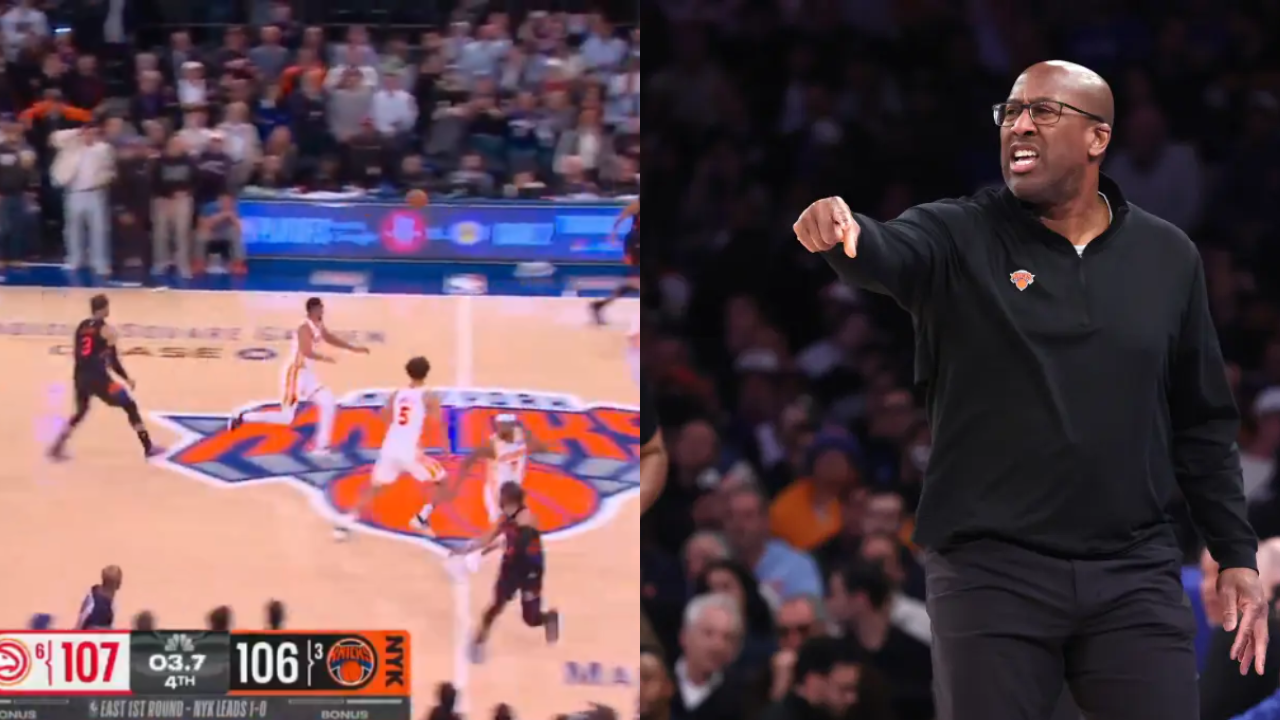
NEW YORK – A phantom timeout that never existed sent Madison Square Garden and millions of viewers into a frenzy during the closing seconds of the Knicks’ 107-106 Game 2 loss to the Hawks on Sunday night. The confusion stemmed from a bizarre combination of coach Mike Brown’s questionable timeout usage with 2:43 remaining, an NBA rule limiting teams to two timeouts in the final three minutes, and a critical broadcast error by NBC that showed the Knicks still had a timeout when they actually had none.
The result was a final possession that left fans screaming for a stoppage that was never available, as Mikal Bridges’ last-second shot missed its mark, tying the series at 1-1.
“I deleted my tweet about the Knicks not taking a timeout because… evidently they didn’t have one???” Fox Sports’ Nick Wright wrote on X. “The broadcast said they did, and the score bug (after initially saying they didn’t have one) said they did, but it appears that was all incorrect. That makes a lot more sense.”
The Confusing Final Seconds: What Actually Happened
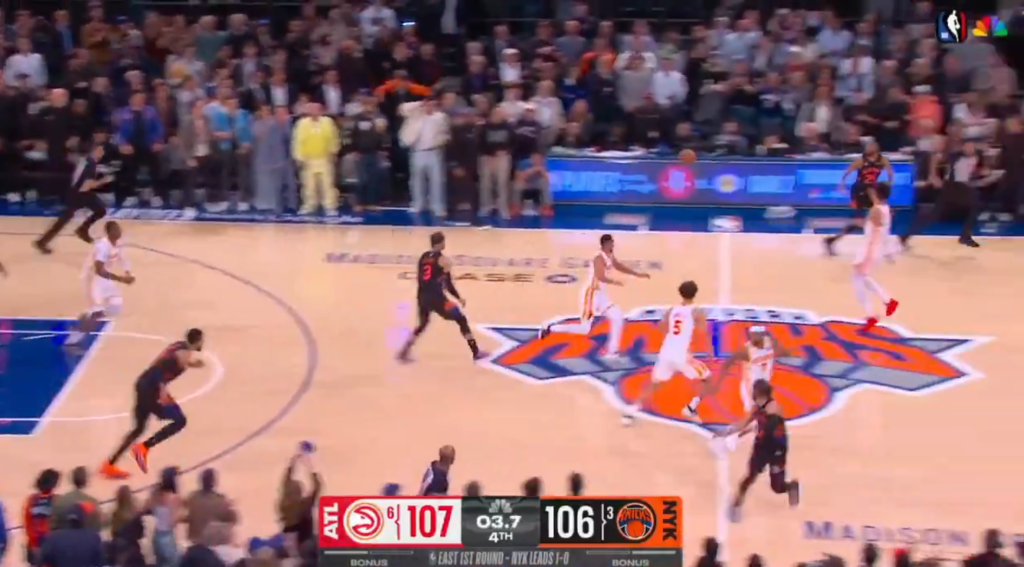
With the Knicks trailing by one point and 5.6 seconds remaining, Hawks guard CJ McCollum stepped to the free-throw line for two shots. He missed the first. After the miss, the NBC broadcast’s on-screen scorebug suddenly showed that the Knicks had one timeout remaining. The graphic had previously shown zero timeouts.
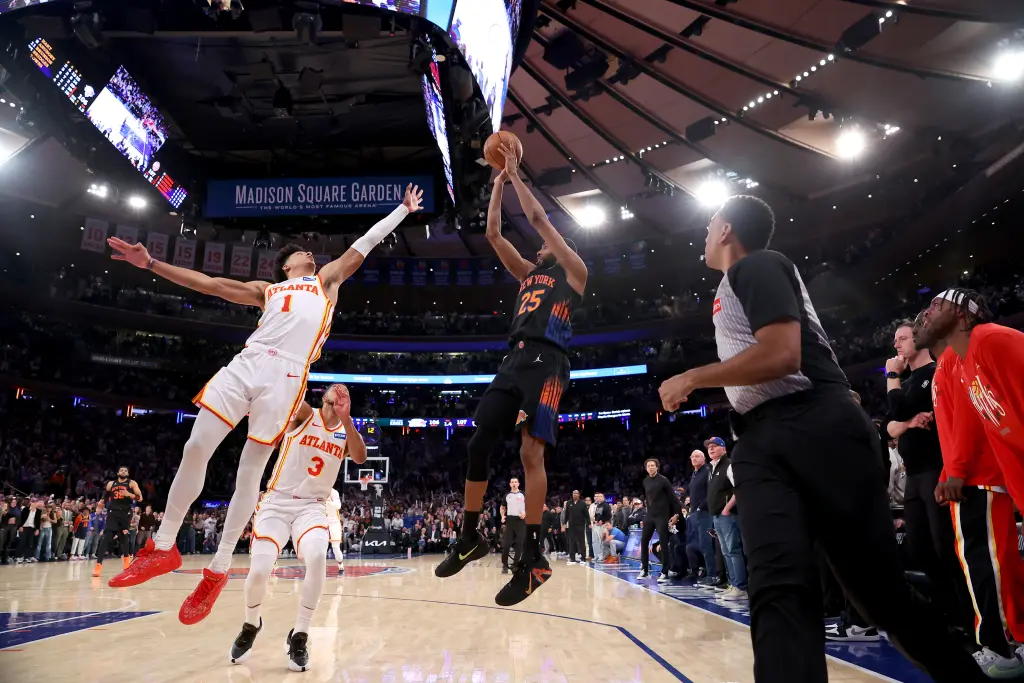
Josh Hart grabbed the rebound off McCollum’s second missed free throw and immediately pushed the ball up the court. He found Mikal Bridges, who rose for a potential game-winning jumper. The shot was contested by Jalen Johnson and bounced off the rim as time expired. Madison Square Garden groaned.
Immediately, social media exploded. Why didn’t Mike Brown call a timeout to set up a play? The broadcast had clearly shown the Knicks had one left.
But they didn’t.
The NBA’s Two-Timeout Rule and Mike Brown’s Odd Decision
The confusion stems from a little-known NBA rule: teams are limited to two timeouts in the final three minutes of the fourth quarter or overtime. Any unused timeouts from earlier in the game are not carried over; a team cannot have more than two timeouts in that final stretch.
The Knicks entered the final three minutes of Game 2 with two timeouts remaining – the maximum allowed.
| Time Remaining | Event | Timeouts Remaining |
|---|---|---|
| 2:43 | Mike Brown calls a timeout | 1 timeout left |
| 0:10 | Mike Brown calls a timeout | 0 timeouts left |
| 0:05.6 (after missed FT) | Broadcast erroneously shows a timeout | Still 0 |
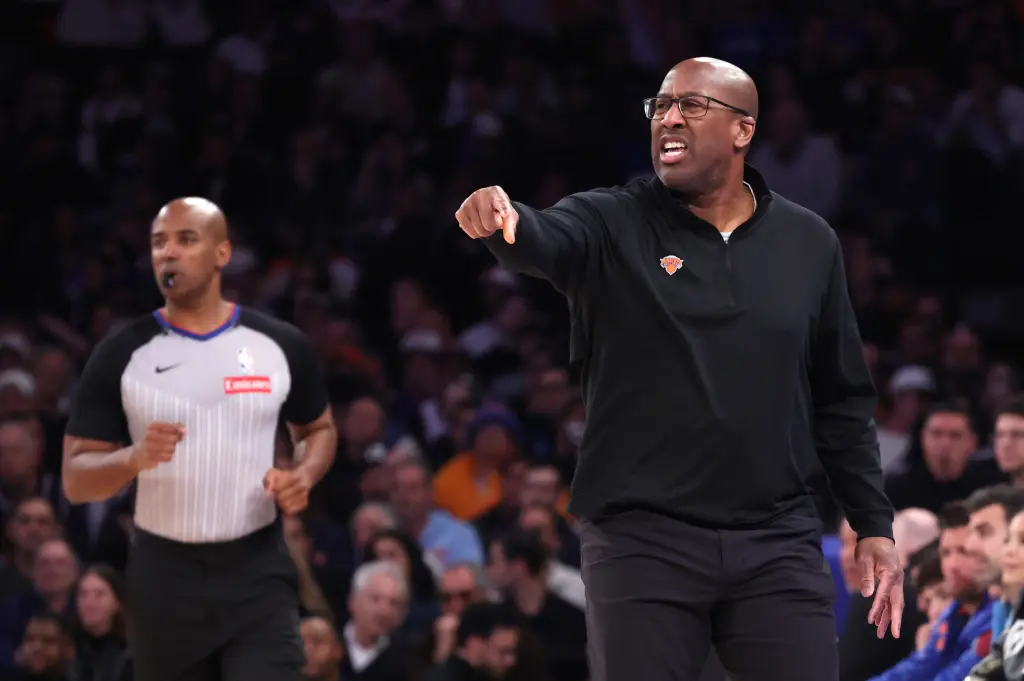
With 2:43 left on the clock, Brown called a timeout while Jalen Brunson was already driving into the lane. The move was puzzling to many observers. After the game, Brown explained:
“A couple of possessions weren’t fluid. So I wanted to make sure that we had something we wanted to get to, or to set something up offensively, because we had whiffed on the last couple possessions. It just didn’t look right, it didn’t feel right.”
Brown then used his second and final timeout with 10 seconds remaining, after a made Hawks free throw, to advance the ball and set up an inbounds play. That was the last legal timeout the Knicks had.
When McCollum missed the free throw with 5.6 seconds left, the Knicks had no timeouts left. The NBC broadcast erroneously added one to the scorebug – a production error that sent fans into a frenzy.
Broadcast Blunder: How NBC Got It Wrong
The mistake appears to have been a simple graphics error. NBC’s scorebug had correctly shown zero timeouts for the Knicks after Brown’s second timeout. But after McCollum’s first missed free throw, the graphic was mistakenly reset to show one timeout remaining. The broadcast team did not correct the error, and viewers were left with the false impression that Brown had a timeout to use.
Sports talk host Zach Gelb captured the frustration:
“I didn’t love not taking the timeout there as the broadcast said they had one, but turns out they didn’t, so makes sense why they didn’t. Holy confusing.”
The error was not corrected during the live broadcast, and it was only after the game that the truth emerged.
Mike Brown’s Postgame Defense: ‘It Was a Good Shot’
When asked after the game whether he would have called a timeout on the final possession if he had one, Brown said it would have been a “gut feel.” He defended the shot Bridges took.
“I thought it was a good shot. I don’t think the shot was under a ton of duress,” Brown said.
Bridges finished with 18 points but was just 7-of-18 from the field. The Knicks’ offense sputtered down the stretch, scoring only four points in the final five minutes.
Karl-Anthony Towns, who had been the Knicks’ most consistent scorer all series, was held to just 14 points on 5-of-15 shooting. He was a non-factor when the Knicks needed him most.
Social Media Erupts: ‘Holy Confusing’
The combination of Brown’s odd timeout usage, the NBA’s little-known rule, and the broadcast error created a perfect storm of confusion on social media.
- Nick Wright (Fox Sports): “I deleted my tweet about the Knicks not taking a timeout because… evidently they didn’t have one???”
- Zach Gelb (sports talk host): “I didn’t love not taking the timeout there as the broadcast said they had one, but turns out they didn’t, so makes sense why they didn’t. Holy confusing.”
- Barstool Sports: The outlet posted a screenshot of the scorebug error with the caption: “NBC really gave the Knicks a timeout they didn’t have. Unforgivable.”
Knicks fans, already frustrated by the loss, directed their anger at both Brown and the broadcast. Some called for the coach to be fired; others blamed NBC for misleading viewers.
The Broader Context: NBA Timeout Rules and Broadcast Errors
The NBA’s timeout rules are among the most complex in professional sports. In addition to the two-timeout limit in the final three minutes, teams also lose any remaining timeouts after the two-minute warning if they haven’t used them. The league has made efforts to simplify the rules, but confusion persists among fans – and, apparently, among broadcast graphics departments.
This is not the first time a broadcast error has caused confusion in a high-stakes playoff game. In the 2023 NBA Finals, a similar graphics error led to widespread misunderstanding about a team’s fouls to give. NBC has not issued a statement regarding the error.
What Happens Next
- Series tied 1-1: The Knicks and Hawks head to Atlanta for Game 3 on Tuesday night. The series now shifts to a best-of-five.
- No discipline for Brown: The coach will not face any penalty for his timeout usage, though fans and analysts will continue to second-guess the decision.
- Broadcast correction: NBC has not yet commented, but an apology may be forthcoming.
- Knicks adjustments: Brown will need to find a way to get Towns more involved in the offense if the Knicks are to take control of the series.
FAQ: Knicks Timeout Controversy
Q: Did the Knicks have a timeout at the end of Game 2?
A: No. Mike Brown used his two allowed timeouts in the final three minutes, leaving the Knicks with zero timeouts for the final possession.
Q: Why did the broadcast show a timeout?
A: It was a graphics error by NBC. The scorebug mistakenly added a timeout after CJ McCollum’s missed free throw.
Q: Was Mike Brown wrong to call a timeout with 2:43 left?
A: Many analysts believe it was a poor decision, as it burned a precious timeout that could have been used to set up a final play. Brown defended the call, saying the offense was not fluid.
Q: What does the NBA rule say?
A: Teams are limited to two timeouts in the final three minutes of the fourth quarter or overtime. Any unused timeouts from earlier are not carried over.
Q: Will the NBA fine NBC or the Knicks?
A: No. The error was a production mistake, not a violation of league rules.
Q: Where can I watch Game 3?
A: Game 3 is Tuesday night in Atlanta, airing on TNT.