
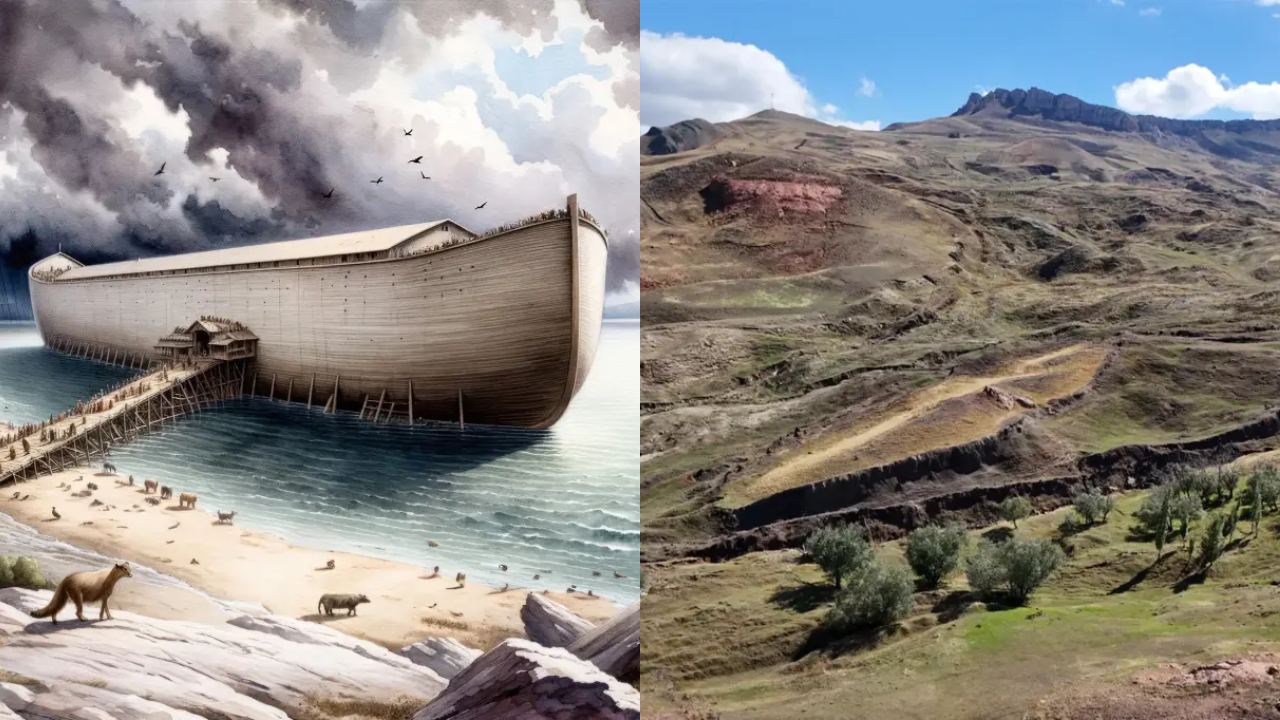
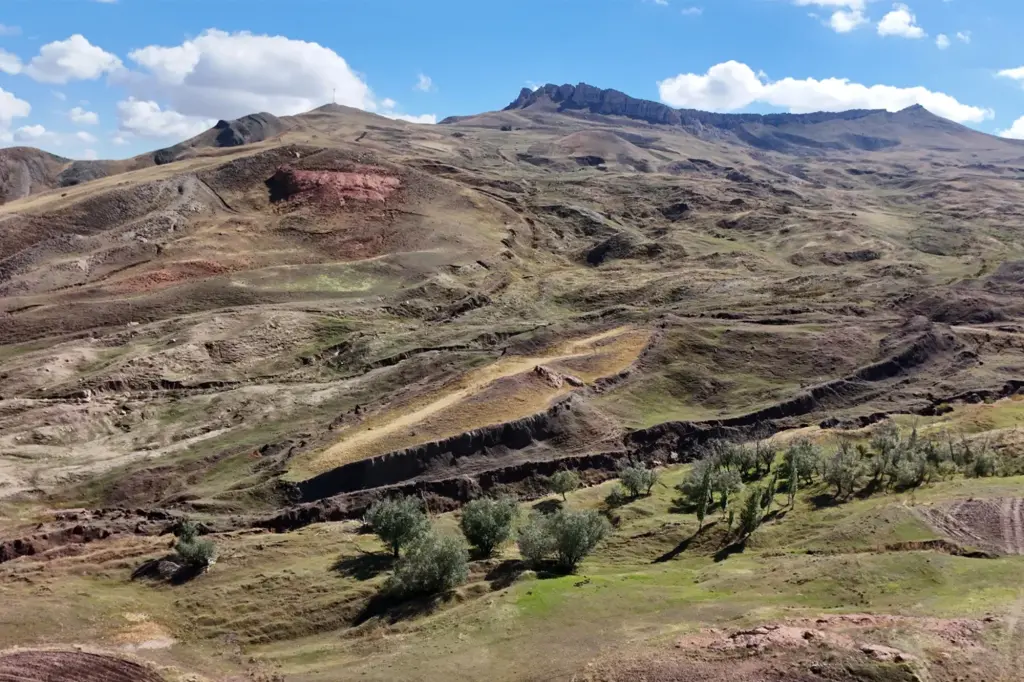
High on the slopes of Mount Ararat in eastern Turkey, a boat-shaped rock formation that has captivated explorers for generations is yielding astonishing new secrets. Using ground-penetrating radar (GPR), independent researcher Andrew Jones and his team at Noah’s Ark Scans have uncovered a network of hidden corridors and a central hollow chamber far beneath the surface – a discovery they say aligns precisely with the biblical blueprint of Noah’s Ark and points to a man-made origin.
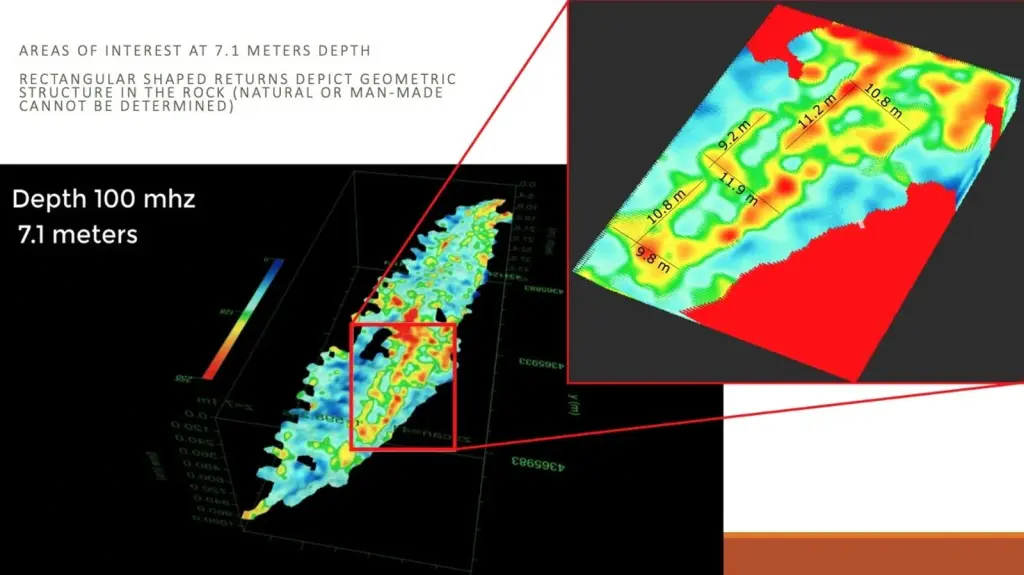
The formation, known as the Durupınar site, sits at roughly 6,500 feet above sea level and measures approximately 515 feet in length – dimensions that match the biblical description of the Ark (300 cubits long, 50 cubits wide, and 30 cubits high) when converted from Egyptian cubits. Now, fresh GPR and infrared thermography (IRT) scans have revealed angular structures buried up to 20 feet deep, including a 13-foot corridor running through the formation’s center and a hollow core Jones has dubbed the “atrium.”
“God told Noah to bring the animals in. And so these animals would have stayed there, plus Noah and his family. What’s interesting is that these voids are lining up below the ground – and they’re not just random,” Jones told GB News. “These tunnels are also following a pattern. GPR is just a way to look below the soil using radar. There’s also been studies done with IRT, which is another geophysical technique – and they’re showing a ship-shaped hull still preserved deep in the soil.”
A Chemical Imprint: Soil Samples Tell a Story
Working entirely without excavation, Jones and his team have also gathered compelling chemical evidence that the formation may not be a natural geological feature. In 2024, they collected 88 random soil samples from positions both inside and outside the ship-shaped boundary.
The results were striking: soil inside the “boat” contained three times more organic matter and 38 percent more potassium than soil just outside. The grass above the formation even takes on a yellower hue in the fall, Jones noted – a visible sign of the chemical anomaly below.
“What that shows is that the soil is unique. And the grass, in the fall, it has a yellower colour just inside,” Jones said.
He believes the explanation lies in the gradual decomposition of an ancient wooden structure. A timber vessel buried for millennia would break down entirely, but the process would leave a lasting imprint on the chemistry of the earth around it – precisely what the data is showing.
“It’s exactly the link given to the Bible. It’s 300 Egyptian cubits. For us, these are all positive lines that we’re pursuing, and it’s showing that there’s more to be found,” he said.
Marine Fossils and a Cataclysmic Flood
The case for the Ark is further bolstered by the presence of marine fossils around the formation. A separate research team – a collaboration between Istanbul Technical University, Agri Ibrahim Cecen University, and Andrews University in the United States – has been working since 2021 under the banner of the Mount Ararat and Noah’s Ark Research Team.
The team collected nearly 30 samples of rock and soil from the site. Analysis revealed traces of clay-like materials, marine deposits, and seafood remnants, including mollusks. Experts determined that the materials dated between 3,500 and 5,000 years old – a timeframe that coincides with the Chalcolithic period, which is associated with the era of the biblical flood as described in Genesis.
“Our studies show that this region harbored life in that period and that, at some point, it was covered by water, which reinforces the possibility that a catastrophic event of great magnitude occurred,” the researchers stated.
These findings suggest that the area was once submerged under water, aligning with the narrative of a universal flood found in various religious texts.
The Durupınar Formation: A Geological Enigma
The Durupınar formation has a long and controversial history. It was initially discovered by a Kurdish farmer in 1948 and brought to international attention in 1951 by Turkish Army Captain Ilhan Durupinar during a NATO mapping mission. The structure is a 538-foot geological feature composed of limonite, a type of iron ore. Its ship-like shape and dimensions have long captivated researchers, but scientific consensus has remained elusive.
Geologists have offered natural explanations for the formation. Some argue that it is a “discontinuity-bounded block of Miocene limestone which has slumped and crept downslope on weak Eocene clays.” Others point to tectonic plate shifts that could have raised the rock formation high above the prehistoric ocean.
But Jones and his team are not convinced. They argue that the angular structures revealed by GPR – including right-angled formations and room-like compartments – are “uncommon in natural geological processes” and “suggest intentional design.”
“The re-analysis confirms what we suspected: These are not random shapes in the mudflow,” Jones told Fox News Digital. “The presence of hallways and room-like structures points to a man-made origin for the boat shape.”
The Robot Explorer: Peering into the Atrium
Jones and his team are now planning their most ambitious move yet: sending a remote-controlled robotic device into the tunnels to explore the hidden chambers directly.
“We have a team that is designing a robotic, remote-controlled device that could go down inside the holes and explore the tunnels,” he told the New York Post.
If successful, the robot could provide the first direct visual evidence of what lies beneath – potentially confirming whether the subsurface structures are natural cavities or man-made compartments.
Skepticism and the Scientific Divide
The Noah’s Ark Scans project has not been without its critics. Many geologists and archaeologists remain deeply skeptical, arguing that the boat-shaped formation is a natural mudflow feature and that the GPR and soil data can be interpreted in other ways.
The most common natural explanation is that the Durupınar formation is a “mud volcano” or a “slump fold” – a geological structure created by the movement of soft sediments. The presence of limonite, a common iron ore, further supports a natural origin.
Even Professor Faruk Kaya, a lead researcher on the university team, has urged caution. While acknowledging the exciting findings, he has stated: “With the dating, it is not possible to say that the ship is here.”
Nevertheless, Jones and his supporters are undeterred. They point to the convergence of multiple lines of evidence: the exact dimensional match to the biblical Ark, the GPR and IRT scans showing a hull-like shape, the anomalous soil chemistry consistent with decaying wood, and the marine fossils indicating a catastrophic flood.
A Symbol of Faith: Evangelical Christian Response
For many evangelical Christians, the discovery of Noah’s Ark would be a profound validation of the biblical account. The Ark is a cornerstone of the Genesis flood narrative, and its discovery would be seen as a powerful affirmation of faith.
However, some theologians have cautioned against placing too much weight on physical proof. As one Christian reflection noted, “The discovery of Noah’s Ark would be interesting but not necessary for faith as God reveals Himself in many ways.”
The search for the Ark has a long history within evangelical circles, with expeditions dating back to the 19th century. The current research, with its advanced technology and compelling data, has reignited interest and debate.
What Happens Next
- Robotic exploration: Jones’ team is designing a robot to enter the tunnels. No timeline has been announced, but the project is actively underway.
- Continued analysis: Additional geophysical surveys and soil testing are planned.
- Academic debate: The findings will likely be presented at future symposia, where they will face rigorous peer review.
- Public interest: The story has gone viral, capturing the imagination of believers and skeptics alike.
FAQ: Noah’s Ark Discovery
Q: What did Andrew Jones find?
A: Using ground-penetrating radar, he discovered a network of subterranean corridors and a central hollow chamber (the “atrium”) within the boat-shaped Durupınar formation on Mount Ararat.
Q: How does the formation match the Bible’s dimensions?
A: The formation measures approximately 515 feet in length, which aligns with the biblical description of the Ark as 300 cubits long (using Egyptian cubits).
Q: What did the soil samples reveal?
A: Soil inside the formation had three times more organic matter and 38% more potassium than soil outside, suggesting the decomposition of ancient wood.
Q: Is there evidence of a flood?
A: Yes. Researchers have found marine deposits and mollusk fossils dating to between 3,500 and 5,000 years ago, indicating the area was once underwater.
Q: Is this proof that Noah’s Ark is real?
A: Not yet. The evidence is compelling but not conclusive. Many geologists believe the formation is a natural mudflow feature.
Q: What happens next?
A: The team plans to send a robot into the tunnels to explore the hidden chambers directly.